About
A game in the form of disclosure, and a pitch you can walk around in.
Above Black is a top-down action-adventure investigation into UAP disclosure, built around Majestic 12 and set in Rachel, Nevada. What you can play today is the smallest playable thing that shows what the game is for.
Most pitches are a document. A document can describe two people disagreeing; it can't put you in the room while they do it. So we wrote the two accounts, put them behind two doors, and let you pick a door.
The record
Majestic 12, at length
The long version. Where the record is contested, we say so.
The paper
The briefing paper reached the world in December 1984, when a television producer said he opened his mail and found a roll of 35mm film. No letter, no sender. Developed, it was a briefing paper dated November 1952, prepared for President-elect Eisenhower, naming the twelve. The FBI looked into it. There's a memo in the file and it's stamped BOGUS. Tenth name down is Donald Menzel, a Harvard astronomer who spent his public life telling Americans there was nothing here at all. Either that's the best cover anybody ever arranged, or it's a forger picking a famous name. Nobody has settled it.
The men on it
The men listed on it are a different matter. They were real, they held those jobs, and you can look every one of them up. Vannevar Bush ran American science through the war. Detlev Bronk mapped what a human body can take at altitude. Nathan Twining ran Air Materiel Command, and in 1947 he put his name to an official memo stating the phenomenon was something real and not visionary or fictitious. Nobody disputes that memo. It's just filed.
Some of the names cost something. James Forrestal was the first Secretary of Defense this country ever had. He went into Bethesda Naval Hospital in 1949 and out a sixteenth-floor window. The press said suicide, and it may well have been one. The Navy board that investigated never used the word, and its report stayed unreleased for fifty-five years. His diaries were published two years later, as an edited selection.
The hard part of this record is rarely dramatic. It's administrative. A file gets declassified with lines removed, and the removals are the part you aren't allowed to read.
What has happened since 2007
None of this is a closed file. A Pentagon program studied the phenomenon between 2007 and 2012, and the public did not learn its name until 2017. In 2020 the Department of Defense released three Navy videos and said the objects in them were unidentified. In 2021 the Director of National Intelligence sent Congress an assessment of 144 military reports and could account for exactly one of them. In 2022 a House subcommittee held the first open congressional hearing on the subject in more than fifty years, and the Defense Department opened an office to collect and assess the reports.
A year later a former intelligence officer testified under oath that he had been told the United States holds craft not built by humans. He said he hadn't seen them himself. The Pentagon has said there's no verifiable evidence for it. Both of those statements are on the record, and the record doesn't say which one is true.
The plan
How the other nine are meant to work
Clearance instead of levels — the locks are in, the keys aren't — and a claims database still on paper.
You aren't touring these. Every region is somewhere you have to get into: a badge you don't have, a shift you're not on, a manifest with your name absent from it. Our working answer to progression is clearance: what gets stronger is how far in you're allowed, rather than how hard you hit.
Behind all ten is a claims database, and every entry carries one of four tags — the four beside this.
The build
What is here, and what isn't
One painted town, nine regions greyboxed and empty, and two systems that exist only on paper.
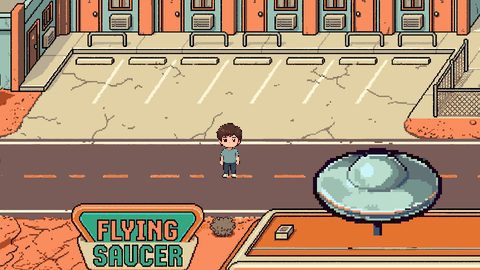
- InSix rooms of Rachel. The highway, the motel with its lobby, bar and breakfast room, room 2, and the diner. All hand-painted, all reachable.
- InSix people. Xander, Chris, Jon and Clint are written through. Bob and Travis say three lines and stop, and both are open jobs.
- InDoor order. Nothing branches. The second person knows what you already heard and speaks to it.
- InSaving. You sleep in room 2. It comes back on the same browser whether or not you have an account; signing in is what carries it onto another device.
- InNine regions, greyboxed. Every other region on the route is built at its real size, with the eight roads between them, and each one is in the build and walkable end to end. Nobody lives in them yet. Four places out there already have a bed — a bunkroom cut out of the rock at Area 51, a trailer off the Extraterrestrial Highway, a meeting hall in Salt Lake City and a berth on a boat in San Diego — and each one saves your game and has its own few lines written for lying down in it. That is the only thing there is to do out there so far, and the demo cannot take you to any of it: the one road out of Rachel wants a badge and a uniform that nothing in this build hands out, so these are walked from the editor.
- InThe world map. Press M and it draws every region, every road and where you are, out of the game's own layout data.
- Not yetCombat. Real time on the map, one hand-authored set-piece per region, no experience points. On paper, and none of it built.
- Not yetThe case file. Designed and unbuilt. Clearance is half done: ten doors already name the badge, the uniform or the ticket that opens them, and nothing yet hands you one.
- Not yetAn inventory puzzle, a way out, or an ending. You stop when you've heard both accounts.
- Not yetThe shape of the full game. How the story branches, what you do besides talk. Join now and you get a say in it.
Who is making it
A very small number of people.
Above Black is a project of Gigabit Arcade, and there are few enough of us that this site has a join page. Rachel, Nevada is a real town. The people in the game share names with real people who have agreed, or are being asked, to appear, and everything they say is written for the game.